
CW: abuse, interpersonal violence (IPV)
I started this blog because I occasionally had a tendency to write novel-length Twitter threads in response to some ill-advised tweet from someone. It seemed better to create a blog instead of expect people to read a 20-tweet-long thread. That hasn’t happened in the time since I started this blog, until now…and, whew, this tweet.
On Sept 6, someone tweeted out that men were 2x more likely to be physically abused in a relationship than women. When someone pointed out that the CDC has shown women are more likely to be physically abused (https://www.cdc.gov/violenceprevention/pdf/nisvs_report2010-a.pdf), he responded by providing the website where he got his statistic (https://domesticviolenceresearch.org/domestic-violence-facts-and-statistics-at-a-glance/) and a screenshot of his specific point, which I am putting below.
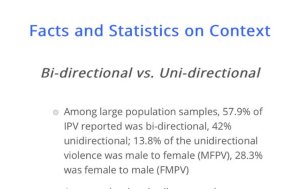
When someone else pointed out that the very same page his screenshot came from stated women were more likely to be assaulted than men (23% to 19%), he changed things up a little bit, saying that his point (the screenshot) was that it meant when there was only one abusive spouse, it was twice as likely to be a woman. (Side note: this was about both dating and married partners, not just spouses…so there is that too).
This person very clearly wants to show women as the abusers and men as the abused, and he says his screenshot clearly proves this is the case. So, that’s it, right? The end…men are more likely to be abused, and its the women doing the abusing? Well…no.
The screenshot comes from a website detailing the Partner Abuse State of Knowledge Project (PASK), which was done in the 2010s. It was a HUGE project that reviewed much of the existing research on abuse, and the review findings were published as a series of journal articles. The website not only provides a fact sheet, from which the screenshot came, it provides links to all of those articles, tons of resources, and some videos. You could spend days going through all of the information.
But, it clearly states women are more likely to be physically assaulted than men, which people tried pointing out to this tweeter, using both the CDC information and his own fact sheet. Instead of being like “my bad, I misunderstood,” he doubled down by saying “well, this says women are more likely to abuse.” He no longer specified that men were more likely to be physically abused and focused instead on women being more abusive in general. So, that’s it, right? The end…women are more likely to be abusive than men when there is only one abusive partner. Well…no.
You see, bidirectionality versus unidirectionality is not quite the “own” that he thinks it is. The studies that were included in this review often used The Conflict Tactics Scale (CTS or CTS2) to measure interpersonal violence. The CTS was developed to measure conflict and aggression in relationships, and people are asked to indicate if they or their partners have committed a variety of behaviors in the past 12-months. If they have committed any of the behaviors, they have been uni-directionally violent; if they and their partner both have committed any of the behaviors (even if they are not same behavior), they are bi-directionally violent.
So, what are the behaviors? Well, they range from sulking (CTS only) instead of talking and stomping out of a room because of a disagreement to raping your partner to choking your partner. So a woman who sulks or stomps out of a room during arguments is being unidirectionally violent; a woman who sulks or stomps out of a room after her male partner has raped her is being bi-directionally violent. The authors of the article the tweeter’s screenshot is based on even explicitly state that it is impossible to know if bidirectional violence, as measured by the CTS, is a result of two aggressive people or one person initiating violence as a form of control and the other responding in a way deemed poor communication (like sulking) or self-defense. In essence, the CTS is not really measuring abuse alone…it is measuring abuse (like hitting), poor communication (like stomping out of a room), and what we might currently call toxic behavior (like doing something out of spite).
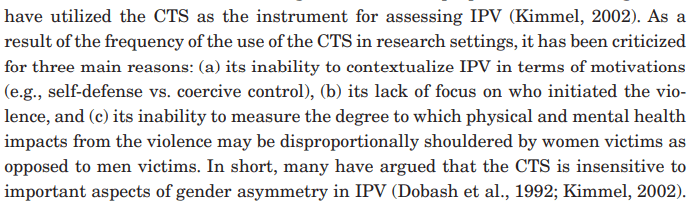
So, whether he really meant to say that men are more likely to be physically abused (his first tweet) or men are more likely to be abused in general (his second tweet), he is wrong. Being as generous as possible to him, the most he could have said was that, when a man and woman are in a relationship, and only one of them is abusive, toxic, or a poor communicator, it is more likely to be the woman. He can’t even say how many of the women are poor communicators vs toxic vs abusive, because the article didn’t provide that information.
In his effort – for whatever reason – to bring some kind of attention to men being abused, he incorrectly conveyed research about IPV to argue that men have it worse than women. It’s worse that he did this in the midst of pushback against John Piper stating women who were only being hurt by their husbands – not being made to sin by them – needed to just “endure” the abuse for a while before going to the church to try to get the abuse to stop. It certainly makes it sound like he is upset people are calling John Piper out for his comments and is saying men have it worse anyway, so who cares if women are supposed to “endure” for a while.
He might, by the way, really just want to draw attention to men being abused. More attention absolutely needs to be paid to men being abused. But the way he has done it is completely problematic. He starts out by making a statement that contradicts his own source. He then tries to “correct” by changing his comparison…but it is clear he doesn’t know about the CTS or the problems identified by the authors of his source. (As a side note, the articles that the fact sheet is based on are linked right on the same website by clicking on a link on the left hand side that says “17 Full PASK Manuscripts and tables of Summarized Studies.”)
But, more than that, he is trying to score some “gotcha” moment about who is more likely to be abused. He is implying some kind of hierarchy, where we should care about abuse because its happening more to men. No, we should care about abuse happening to men, because men should not be abused; we should care about abuse happening to women, because women should not be abused. We should call out people like John Piper, who think women should just endure abuse for thinking women should just endure abuse. We should not be responding to people calling out John Piper with anything like “well, women abuse men more than men abuse women.” We especially should not be saying that when that is not what our cited source says.
The fact that boys and men being abused is seldom discussed is a problem. We should absolutely make space for boys and men who have been abused. We should NOT make that space by implying that their abuse is more important or misuse data to argue that they are the more important victims. We should NOT interject into discussions of the outrage about a male pastor telling women to endure their abuse to misspeak about research and claim women abuse men more than men abuse women. Doing so is no different from people who interject into conversations about the silencing of male victims to talk about how many more women are abused than men. And, for the love of all that is good and holy, do not misstate research when you are trying to make your claims…because at least the people talking about women being abused more often are accurately conveying the research.
Abuse is bad. No one should be abused. However, men being abused are not more important than women being abused (and vice versa). No one should be told they need to “endure” abuse, and no one should try to score points in a discussion about how awful it is women are routinely told that by arguing (incorrectly) women are more abusive. Don’t abuse anyone. Don’t expect anyone to “endure” abuse. Don’t make the abuse of one group more important than the abuse of another group. Rather than trying to create a hierarchy within abuse victims and survivors, offer all of them support, speak out against abusers and abuse enablers, and work to dismantle the aspects of society that encourage abuse of all people to continue.


Leave a Reply